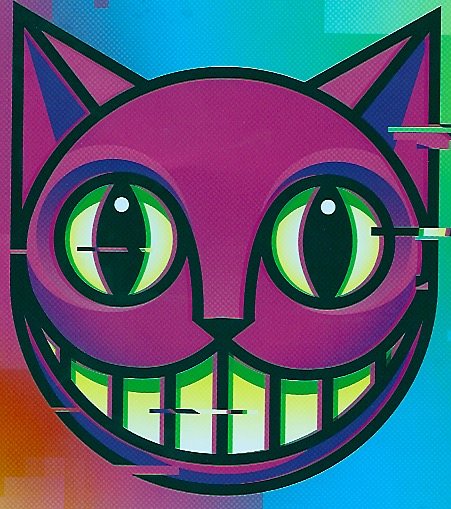
The Cheshire Cat from
wonder.land ……….
Well, it would be fair for you to turn the question on us: who are you? Of course, you know the short answer to that : we are ‘Penny and Bob’. They are our so-called Christian names. But the question pushes us into a hole (like the one Alice fell into?). Who are we? What are we? Where do we come from? Where do we go? Do we like who we are? Would we rather be someone else? (Taller, smaller, fatter, thinner, happier, brighter, sharper, sexier)? Would it be possible to be someone else? How might that be possible? Well, actors ‘play’ that all the time, don’t they? When we are thinking about these issues, how do our thoughts work? Are they just electric currents which translate in our ‘minds’ into words? How do we debate these questions within ourselves, within our minds? Do we debate them with words? Where do our thoughts come from? If there are voices, are they all inside us? Or do some come from outside? What tells us to stand up, or sit down. or to laugh or to cry? What tells us to tread carefully on the edge of the cliff? When someone jumps, who or what tells them to leap into the unknown? Why don’t we all leap off the cliff? Because we are ‘wise’, ‘balanced’, sane?’ Are our answers today the same as they might be tomorrow? There are others, perhaps you, perhaps your partner, your friends, your children or your friends’ children who do not think like you/us. Some say they hear voices. Some of them are ‘bad voices’, which encourage self harm. Those young who discover and take take drugs have their thinking and actions confused. Some characters choose to escape into another world, change their personae, explore another country, especially in fiction through a wardrobe door or hole in the ground. Sometimes we do not choose to enter a hole in the ground. In Lewis Carroll’s story of Alice in Wonderland, Alice chooses to follow a White Rabbit down a hole into a fantastic world where she meets a host of creatures and ‘human’ characters. She has an encounter with a caterpillar sitting on a mushroom which has magical properties, a pigeon who thinks Alice is a thieving serpent, she meets a Duchess, a grinning Cheshire cat, a cook. The Cheshire cat directs Alice to the March Hare’s house, where the Mad Hatter and the Dormouse are having tea together – trapped in perpetual ‘tea-time’. Alice escapes through a door in a tree. She meets the angry Queen of Hearts and the King of Hearts who tries to arrange for the Cheshire Cat’s execution. But since by this time the Cheshire Cat in Wonderland is only a head floating in mid-air no-one can agree on how to behead it. The Queen orders that Alice be beheaded. But Alice suddenly grows HUGE and knocks over the Queen’s army of playing cards. Alice wakes up and finds herself on a river bank from where she began her adventure. What has this Alice invented by Lewis Carroll got to do with anything? Well, as Rufus Norris, the Director of the new musical wonder.land comments: ‘There are some big, big questions, about identity and self-determination, which are absolutely at the core of the original story.’ Moira Buffini. who wrote the script of the new musical wonder.land says, ‘it’s the relationship between the real world and wonder.land that makes the story work. It’s the words of the Caterpillar: “Who are you?”. That’s become the central question of the piece.’
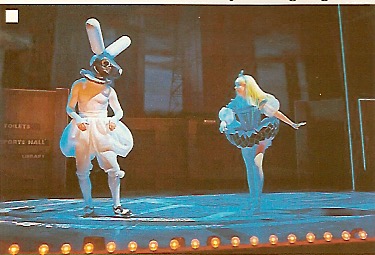
Aly’s Avatar/Alter Ego and the White Rabbit wonder.land Palace Theatre Manchester
Rufus Norris suggests that until the internet opened up many children felt like ‘they weren’t what they should have been. In terms of inclusivity and social confidence, (the internet) has totally transformed the landscape.’ Robert Douglas-Fairhurst, exploring the ‘origins and afterlife of Alice’ writes, ‘Wonderland has developed into something much bigger than the fantasy of one imaginary little girl. Instead, it has become a way of thinking about all the other worlds into which we might want to escape when real life seems too much for us, or perhaps not enough to satisfy us.’ So the question ‘Who are you?’ turns into ‘Who in the world am I?’ ‘Ah, that’s the great puzzle!’ thought Alice. And now ‘off line’ is boring. As Aleks Krotoski has written, ‘To achieve a basic level of stimulation, we need technological enhancement. Games, blogs, Tumblr, Instagram, WhatApp, Streaming, sex, Snapchat. Elsewhere is so much more exciting than here.’ And so Aly in wonder.land finds it.
The Game Penny Fowler i Pad print
The Independent’s critic summarises the show’s premiss: ‘Wonder.land is a place where everyone ‘can be exactly who you want to be”. The show’s heroine Aly – a ‘mixed race miserable teenager whose parents have separated’…creates an Alice avatar in which Aly is whiter, thinner, blonder and more glamorous than in real life. The interaction between Aly and Alice promises intriguing interplay between aspiration and actuality.’ Aly does not fall down a hole or go through a wardrobe door to find her alter ego. She invents it by the simple device of finding a computer game,wonder.land, which she enters through the screen of her mobile phone. Perhaps one of the most spectacular, inventive and astonishing accomplishments of the production is to see what Aly sees on her mobile reproduced technicolour on full stage screen – then, lo and behold! the caricatures of Aly’s dreams step on to the stage as flesh and blood characters. They are ‘human’ and ‘animal’ – ‘stunningly costumed’. Included are the giant caterpillar, made up of four actors, with the leading actor in the head singing the captivating and demanding song, WHO ARE YOU? which summarises what all the action is about. It is comic, beguiling, surreal, threatening, always challenging. Cyber Space becomes ‘a contemporary equivalent’ of Lewis Carroll’s wobbly Wonderland.The Rabbit hole down which Alice falls is available to every contemporary teenager – for the present via the internet. Whether or not there can be a happy ending very much depends on how well Aly, Alice or any of us can distinguish the real world from the psychedelic, and confront it. These questions are not only worried at by teenagers and adults now. Matthew Arnold in 1855 in his poem, The Grand Chartreuse, asks, as he surveys the Carthusian monastery: ‘And what am I, that I am here?’ Is the monastery another world of escape/discovery? The late Sir Herbert Read, author of On Beauty, in his Foreword to Themes in Life and Literature ( R.S.Fowler Oxford University Press 1967) writes of the dangers of confusing ‘escape’ – with ‘distraction’. (Falling down the rabbit hole?) He warns that when we wake up, if we have merely indulged in distraction, we experience a ‘hang-over’, a painful emptiness – ‘no melody to the ear, no understanding of the World. We have been ‘on a mental binge and wake to a sense of desolation and disillusion.’ It is up to each of us to decide what kind of experience we receive from the Musical wonder.land. For many, we believe, it can bring a greater understanding of the world we and our children currently inhabit. There are certainly melodies to the ear, recollections of wonder and conciliation and a comforting promise of Happy Ever After.
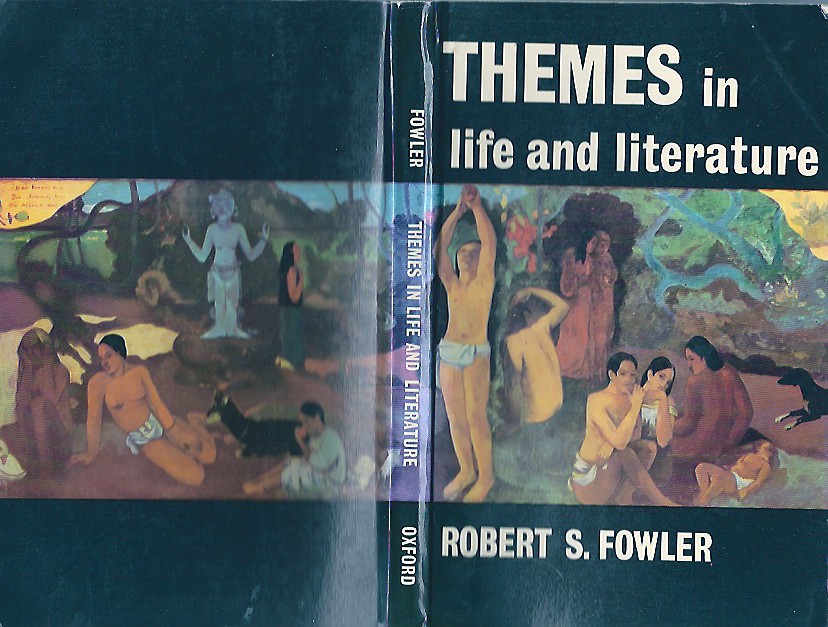
Where do we come from? What are we? Where are we going? Paul Gauguin 1897 Cover of Themes OUP 1967
********************************************************************************* The new Musical wonder.land premiered at the Palace Theatre 2nd July 2015 – A Manchester International Festival/National Theatre co-production. Director: Rufus Norris Book & Lyrics: Moira Buffini Music: Damon Albarn Set Designer: Rae Smith CAST Sam Archer-Dum, Lois Chimimba- Aly, Rob Compton- The White Rabbit, Rosali Craig- Alice, Ivan De Freitas- The Dodo, Luke Fetherston- The Lizard, Hal Fowler- The Cheshire Cat & The Caterpillar, Anna Francolini – Ms Manxone, Lorraine Graham- Ensemble, Paul Hilton- Matt, Karina Hind- Kitty, Holly James- The Hedgehog, Sam Mackay-Dee, Daisy Maywood – Mary Ann, Enyi Okoronkwo- Luke,David Page-The Mouse, Golda Rosheuvel- Bianca, Cydney Uffindell-Phillips- The Mock Turtle, Witney White- Dinah. wonder.land opens at The National Theatre 27 November 2015. wonder.land opens at the Theatre du Chatelet, Paris, in 2016. wonder.land was commissioned by Manchester International Festival, National Theatre and the Theatre du Chatelet.
 penny and bob