The late Poet Laureate, Ted Hughes, in Meet My Folks gave the title
My Father’s the Chief Inspector of Holes
to one of his poems.
I was friendly with Ted especially through the early days of the Arvon Foundation. Indeed, he offered me what I regarded as a generous and complimentary critique of one of my short verses penned during our first experience of Sheffield as residents. It was 1979, the year when even the grave diggers went on strike and it was a savage winter. I summarised my feeling about Sheffield briefly:
Spring
Struggles
To come
To Sheffield.
“A masterpiece of brevity and observation. I wish I had written it!” Thanks, Ted….But I should have asked you if your father really was the Chief Inspector of Holes.
While we are talking about Inspectors I might as well confess that my elder brother, Bill, my cousin Vic and yours truly were (for a while) all HM Inspectors. Yes, a Fowler/Farthing mafia in the Department (Ministry) of Education. My mother, Breta, used wickedly to boast to her friends in the Mothers’ Union where she was the enrolling Member (earned you an invitation to a Royal Garden Party)…used to boast that both her sons and nephew were in ‘The Ministry’. I do not know what Breta would have told them if we all had been Inspectors of Holes.
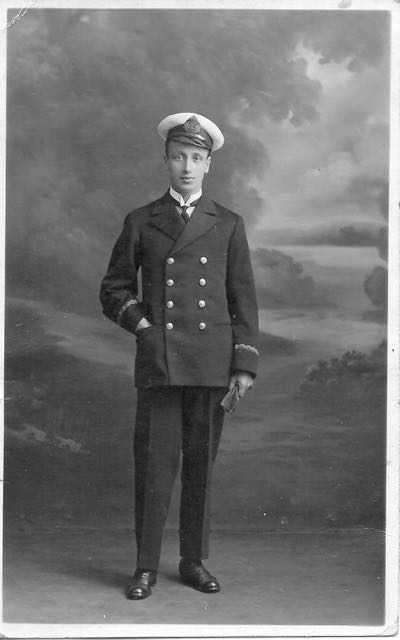
Marconi Radio Officer William Fowler
I want to tell you a little about my father, Willie or Billy as he was variously called. He was not an Inspector of any kind. My earliest happy memories of him as ‘dad’ are when in the evening I would sit on his knee and he would tell me stories. He was a good story teller. I remember best his telling of the exciting adventures of Dick Turpin and his good horse, Bess. Then of course there were Robin Hood and Will Scarlet. Invariably there was a character he dubbed ‘the Little Old Lady’. She was always a mysterious force for good and later reflection led me to believe that the Little Old Lady was probably based on Old Mother Shipton and Mrs Shipton’s cave – you can still visit her ‘home’ in Yorkshire. However the very best story for me was dad’s hair rising adventures at sea.
MY dad lived his youth during the days when tuberculosis (TB) was not uncommon. His much beloved elder brother, John, died young of TB. Billy decided that the safest profession was at sea where hopefully there would be less chance of catching TB. The loss of the Titanic had stimulated debate about the necessity to have qualified radio operators on all licensed ships. Marconi was the brand name in the market. If you qualified as a radio operator with Marconi, you were entitled to wear the Marconi designed embroidered M on your cap – a great treasure. So, Billy took himself off to London to train as a Marconi operator and on 19 November 1913 he was awarded a certificate of Proficiency in Radiotelegraphy by the Postmaster General which authorised him to ‘operate as a first class operator on board a British ship’. He was just 21 – and the Great War was looming. Billy was formally appointed to the Staff of Marconi on 8 February 1914 at a salary of £1 per week. (That would normally be implemented by the owners of whichever ship he served on.) His first Marconi increase in salary was on 7 February 1915 – a rise of two shillings and sixpence. (All these details are recorded in the Marconi Records now stored in the Bodleian Library, Oxford.)

So Billy began his life at sea. One of the sea stories I asked for over and over again was how dad got the better of a Captain Kelly. Captain Kelly, a big, bullying man, I understood, was in the habit of calling my dad ‘Sparks’. Dad did not care for that – he was proud of being a Marconi Radio Operator – and often he was the only Operator on the ships he sailed in. (It had become compulsory for all sea-going ships to have a qualified radio operator on board, even if it was only one, and the 1914 war with Germany had just begun, making radio Officers essential in the case of distress.) Anyway, Kelly called my dad Sparks. Dad requested Captain Kelly NOT to refer to him as ‘Sparks’ but by his proper name and rank. I loved this story, when my dad imitated Kelly’s response – waving his fists in the air and demanding, “And what will you do, Sparks, if I don’t, heh?! What will young Sparks do?” My dad, cool as cucumber, as they say, replied, “Captain, I will call YOU, KELLY!
I imagined the scene – the big, red haired, blustering Kelly, and my not very tall dad, standing up to him and ‘cheeking him’. I used to hold my breath waiting to hear Captain Kelly’s reaction. (Did they still put sailors in irons, or make them walk the plank, or order them 50 lashes? I do not think those options were open to Kelly.) Kelly retorted ” Want to be clever with me, do you Sparks? Very well, I am stopping your wages immediately. You will not receive any pay!” And with that, Kelly marched off.
“And what did you do then dad?” (I knew very well because I asked for and heard the story many times). ‘”Well, Bobbie (I was sometimes Bobbie, sometimes Bob), I went to my radio cabin and sent a morse code message to Marconi in London, telling them that Kelly, the Captain, was witholding my pay.
“Then what happened?” (I knew very well but wanted to hear it again).
“Well Bobby, then I got a message back from Marconi in London to take to Captain Kelly.”
“What did you have to tell him?”
“Captain Kelly, I have a message for you from Marconi: In view of the fact that you are withholding my pay Marconi are withdrawing my services from the ship. You are to proceed to the nearest port where Marconi Radio Officer Fowler will disembark.” I loved it. “What did Kelly do dad, what did he do?”
“What could he do, Bobbie? If I left the ship he couldn’t sail without a radio operator. He HAD to pay me! End of story!” How I loved my clever and brave dad standing up to and winning against Kelly!
The most exciting to me of my dad’s stories was the hair raising drama of a real war encounter. He was sailing in an unarmed merchant ship when he received a morse message for the Captain, “Proceed to Gibraltar to have a Cannon fitted”. They sailed into Gibralter, the cannon was fitted, they returned to sea, now armed, into the Bay of Biscay. ‘All hands on deck!’ The look out had spotted a German U boat on the surface. The gun crew hastily fitted a shell into the new cannon, and fired. The U boat was still there. Crew went to load a second shell. No luck! Help! The breech was jammed. Feverish work on the cannon.The submarine approached nearer.
It was time for Billy to be tested. Only he could get a message out calling for help. He started tapping the morse key. NO SIGNAL! Billy suddenly remembered that the Scottish captain liked to preserve the ship’s energy supplies and had the habit of running at less than full power – hence inadequate electricity supply for the radio cabin.The u boat was approaching. Billy raced to find the captain and demanded an immediate return to full power. Electricity restored to his apparatus Billy was just finishing an SOS call (… —…) when a worker from the engine room snatching some fresh air on deck ran to Billy’s cabin and shouted in, “Master, Master! Torpedo he come!”
The torpedo exploded amidships. The U boat approached and megaphoned the crew to swim to the U boat. (The known practice was for the U boats to submerge when any rescued ‘enemies’ were on the U boat deck). At that moment, from over the horizon, a British destroyer appeared, moving at full speed and firing all its guns. BANG! BANG! BANG! Dad’s SOS had been received. The sub swiftly submerged. The crew of the ship made into the lifeboats. The last they saw of the ship was the mast disappearing below the waves with the mascot monkey clinging to the top. Then awesome silence and emptiness save for the vision of the approaching destroyer. It reached the life boats. Another loud hailer: “We can only stop for 5 minutes. Swim for it.” Billy was amongst those picked up – without his hat or 21st gold watch – but with the valuable platinum which he had the calm to remove from his equipment and store in his waxed tobacco pouch – the true Yorkshireman.
The destroyer had only just started its patrol so the rescued men had to sleep anywhere they could find until the patrol was completed. My father claimed that he had slept with his head on the ammunition pile.
Safe on land Billy returned to Liverpool where his parents were then living – his mother, Emma, bed ridden and a sick woman. In the story the first thing Grandma Fowler asks her boy, Billy (she was not told of the sinking) was, perceptively – “Willie! Where is your hat? If that Kaiser Bill has harmed a hair of your head I’ll be out of this bed and deal with him….”
No wonder my dad was able to stand up to Captain Kelly!
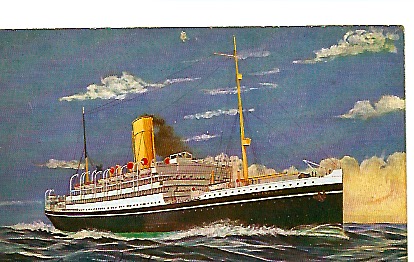
The S/S MARLOCH – one of the ships Billy sailed on.
(* Readers interested in current radio activities and practice : Go to one of the data bases for radio enthusiasts – e.g. QRZCQ.
The Radio Officers’Association (ROA) has a wealth of information about meetings and Records.
The Bodleian Library Oxford now holds the majority of existing Marconi records, including the details of each Marconi Radio Officer, date of employment, salaries, date of leaving the service or ‘Failed to return from War Service’. )
 penny and bob